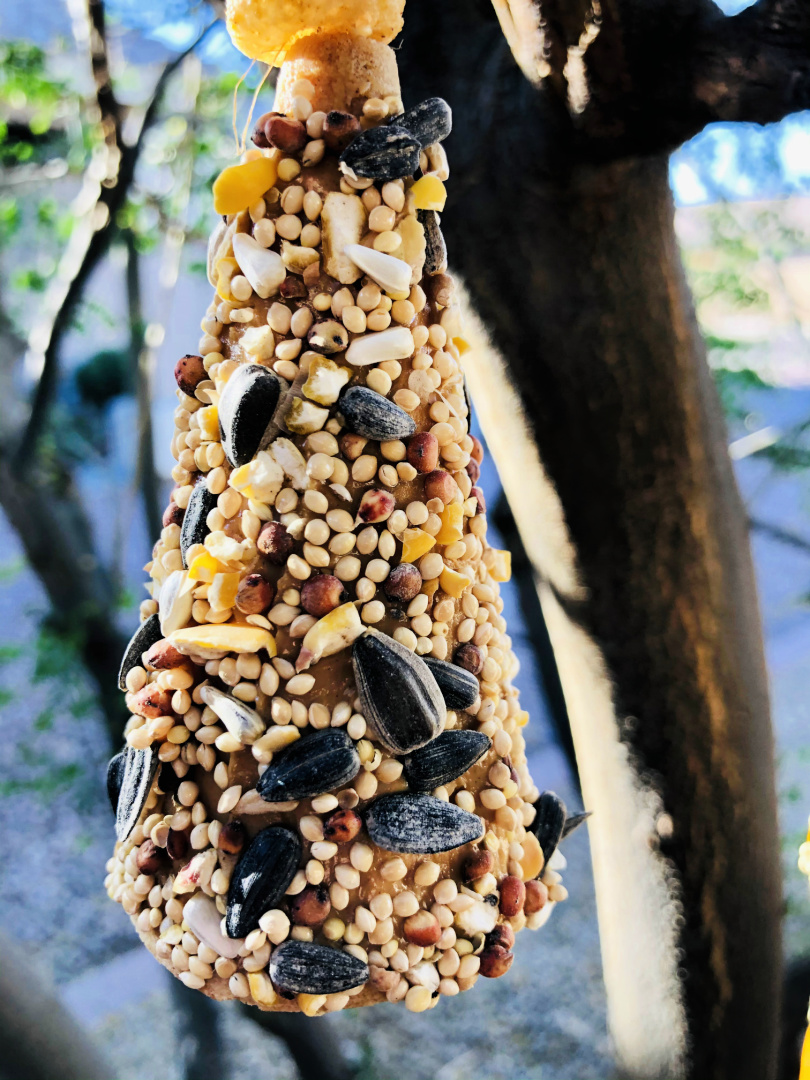
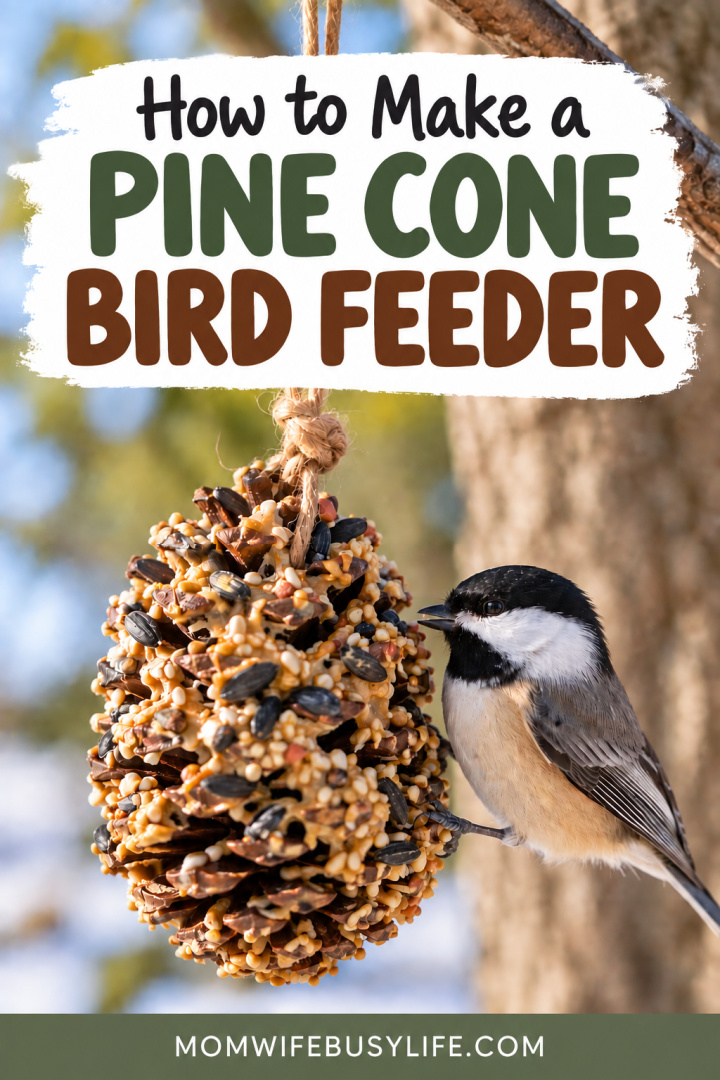
Learn how to make this simple Sugar Cone Bird Feeder to hang in your backyard this season!
If you enjoy birdwatching, consider making homemade birdfeeders for your backyard! There are several varieties of bird feeders that you can make to hang in your backyard this season.
Today, I’m sharing how to make a Sugar Cone Bird Feeder for your birds to feast on this winter or spring season!
Here are my other homemade bird feeder options to try, too!
Bird watching is a fun activity for the whole family!
We recently moved to a new location this spring. About a week after we moved, we purchased a few bird feeders to place around our home. Within days, we observed several different types of birds enjoying tasty snacks from our feeders!
Now that we’ve been here for a few months, we’ve noticed that the birds stick around! We observe cardinals, blue jays, woodpeckers, chickadees, titmice, mourning doves, and other small birds!
We’ve learned a lot from bird watching this year and we plan to continue to feed our daily visitors as long as they keep coming back!
If you want to get started with bird watching, here are a few DIY Bird Feeder Kits to help! Kids will love creating their own bird feeder to display in your back yard.
Are you a busy mom looking for a fun activity that’s both enjoyable and educational for your kids?
Look no further! Making homemade pine cone bird feeders is a great way to spend quality time with your little ones while helping your feathered friends.
Bird Feeders for Children to Make: Includes Apple Feeder, Orange Feeder, Sugar Cone Feeder, Gelatin Feeder, Toilet Paper Roll Feeder and more!
It’s an easy craft that kids of all ages can enjoy, and it’s perfect for introducing young children to the joys of bird watching right from your kitchen window.
Supplies Needed:
Large pine cones
Natural peanut butter (or chunky peanut butter if you prefer)
Bird seed (black-oil sunflower seed is a great high-protein food for wild birds)
Plastic spoon, popsicle stick, or butter knife (for spreading the peanut butter)
Paper plate
String or a piece of twine
Paper towels or a paper bag for clean-up
Directions:
First Step: Prepare Your Pine Cone
Place the pine cone on a paper plate. This will be your workspace to catch any mess.
Spread the Peanut Butter
Using a popsicle stick or a butter knife, spread a little peanut butter around the pine cone. Aim to cover as much of the pine cone as you can with a thin layer. This step is not just much fun but also a great opportunity for your kids to develop their fine motor skills.
Roll in Bird Seed
Pour some bird seed into a shallow dish or a deep bowl. Roll the peanut butter-covered pine cone in the bird seed until it’s well-coated. This can be a bit messy, so having paper towels on hand is a good idea.
Attach the String
Tie twine around the top of the pinecone, creating a loop for hanging. Make sure it’s secure, as you’ll be hanging this new feeder from tree branches in your backyard.
Hang and Enjoy
Find a good spot on a tree branch, preferably visible from a window, and hang your homemade pine cone bird feeder. This is a perfect feeder for different birds, especially during the winter months when blue jays, and other kinds of birds, frequent backyard feeders.
Bird Watching Fun
Now comes the best part! Sit back with your little ones and watch as a wider variety of birds visit your new pine cone feeders. It’s a delightful way to teach your kids about different birds, their eating habits, and the importance of caring for wild animals.
Tips and Variations:
For those with peanut allergies, alternatives like sunflower seed butter or soy butter can be used.
Experiment with different types of seed to attract a variety of birds. Larger seeds might attract blue jays, while smaller seeds like black-oil sunflower seed are perfect for smaller birds.
If you’re interested in more outdoor activities, consider using different materials like fruit pieces or nut pieces in your feeders.
For an extra educational twist, participate in national bird feeding month activities or learn about the birds that visit your feeders.
Creating a simple bird feeder using a pinecone, some peanut butter, and bird seed is not just a fun project; it’s a great way to spend time with your kids, teaching them about nature and the importance of caring for our feathered friends.
It’s an easy pine cone bird feeder craft that doesn’t require a lot of time or resources but offers a lot of enjoyment and learning opportunities.
So, grab those pine cones and get started on this great project today!
Tip: Create a few pine cone feeders and place them around different areas of your yard. Try to see which location attracts the most birds and discuss why the reason why it may be a hot spot!
Are Pine Cone Bird Feeders Good for Birds
Yes, pine cone bird feeders are good for birds. These pine cone bird feeders provide food for birds in need of a food source, especially during the winter months.
Pine Cone Bird Feeder
Materials
pine cones
peanut butter
bird seeds
plastic spoon, popsicle stick, or spatula (to spread the peanut butter)
paper plate
Instructions
Place the pine cone on a paper plate.
Using a plastic spoon or spatula, spread peanut butter around the pine cone. Try to cover as much of the pine cone as you can with a thin layer of peanut butter.
Once the pine cone is covered in peanut butter, roll the pine cone around in the bird seeds until the pine cone is covered with bird seed.
Tie a string at the top of the pine cone and hang from a tree in your yard.
Sit back and wait for the birds to arrive and enjoy the seeds from the pine cone bird feeder!
Frequently Asked Questions for Making a Pine Cone Bird Feeder
What type of pine cones are best for making bird feeders?
Large pine cones are ideal for making bird feeders as they have more surface area to spread the peanut butter and hold the bird seeds. Look for ones that have open scales, which make it easier to get the peanut butter and seeds into the crevices.
Can I use crunchy peanut butter instead of smooth peanut butter?
Crunchy peanut butter can work just as well as smooth peanut butter. It adds extra texture and nut pieces that birds might enjoy. However, ensure that it’s at room temperature to make spreading easier.
Is it safe to use peanut butter for bird feeders? What if there are peanut allergies?
Peanut butter is generally safe and a popular choice for homemade bird feeders. However, if there are concerns about peanut allergies, alternatives like sunflower seed butter can be used.
How do I hang the pine cone bird feeder?
Tie a piece of twine or string around the top of the pine cone. Make a loop or a slip knot for easy hanging. Choose a spot on a tree branch where birds feel safe and can easily access the feeder.
Can I make these feeders during the summer or are they just for winter months?
While these feeders are particularly beneficial during the colder months when food sources are scarce, you can absolutely make them year-round. Birds appreciate the extra food and it’s a great way to observe different birds in various seasons.
What kinds of birds will the pine cone bird feeder attract?
The types of birds attracted will depend on the bird seed used. Smaller seeds like black-oil sunflower seeds are popular with a variety of birds, including finches and sparrows, while larger seeds may attract bigger birds like blue jays.
How long will the pine cone bird feeder last?
The feeder will typically last a couple of days to a week, depending on weather conditions and bird activity. Check periodically and replace when necessary.
Are there any mess-free alternatives for younger children?
For a less messy activity, consider using pipe cleaners to make simple feeders. Thread cereal or small pieces of fruit onto the pipe cleaners and bend them into shapes for hanging.
Can I add anything else to the bird feeders for variety?
Feel free to experiment by adding fruit pieces, nut pieces, or different types of seeds to attract a wider variety of birds.
What should I do if the pine cone bird feeder attracts unwanted animals?
If unwanted wild animals like squirrels are a problem, try hanging the feeders higher or using a feeder pole with a baffle. Be mindful of where you place the feeders to avoid attracting animals close to your home.
Get creative with paper plates! Here’s a list of Animal paper plate crafts for kids to make this year.
No matter what animal is their favorite, kids will love creating, painting, and decorating their new animal friends they have made. Paper plate crafts are also a way to help kids work on their fine motor skills, learn colors, measuring and so much more.
If you are looking for some fun animal themed paper plate crafts, these cute little creatures are the perfect place to start.
Spark joy with these colorful rainbow creations! With a paper plate, cotton balls and a little paint you can make your very own rainbow Mickey Mouse craft!
Kids will proudly share the loves, passions, interests and skills in this All About Me project inspired by Charlotte’s Web. They’ll also love creating their very own spider craft!
This paper plate goldfish is easy for kids to paint and draw with. They can get as creative as they want with their fish giving it color, glitter, and anything else!
Are you trying to keep the kids entertained during the hot summer months? Here’s a list of fun indoor activities for kids to take advantage of!
We all hate being cooped up on those rainy days, and throughout the cold winter months. Here are ten tips and tricks that I do to keep my little ones happy and be stress-free.
I am a stay at home mom of three. They haven’t been able to get out of the house, except for running errands, for weeks. Reading them stories, and the same old routines haven’t been cutting it! They are bored, and it’s stressful for everyone.
Indoor Activities for Kids
Build a fort
My kids love forts, the bigger, the better! Although they are small, and can only help minimally with constructing the fort, the hour that I spend making super-sized fort keeps them busy for the afternoon. There are a lot of activities that they do in the fort. For instance, coloring, blocks, hot wheels, dolls, etc. I let them eat a snack in there fort as well. I always make sure the fort is big enough for me to join in on the fun. Some simple fort designs and tips:
Easy tabletop fort: spread a sheet over the tabletop and anchor to the chairs with clothespins or safety pins
Tarp fort: small tarps are cheap, and you can buy them just about anywhere. You may also need a clothesline. String the clothesline through the grommets and tie to sturdy furniture. I like darker tarps so my children can use their kiddie flashlights.
Pop up tent fort: Pop up tents are the most expensive fort of the three, but the cost doesn’t usually exceed over $20.00. Pop up tents fit anywhere and are easy and quick to put up and take down. You can buy a larger or smaller tent. I’ve tried all three, and pop up tent forts are definitely my preference.
My kids get super excited when I take every pillow and blanket in the house and pile them on to the living room floor. I even empty my linen closets. Also, before I put the blankets and pillows down, I make sure there are no toys on the floor. Also, I put away table lamps, picture frames, and anything breakable in a box and remove them from the room.
Homemade play dough
I love to make NO COOK homemade playdough! It’s quick and easy for me and keeps the kids busy for hours and me. I also find safe utensils and toys that make great patterns in the dough. The recipes are easy to find online.
Schedule T.V. time or movie time
This is a very controversial subject, for all. Even my T.V. rules are strict, slim to none actually. On these homebound days, I allot a certain amount of educational T.V. time or movie time. I like to check my local newspaper for T.V. guide listings or go to www.tvguide.com. This way here you can find the shows you want your kids to watch, and when you schedule ahead of time, it will give you peace of mind to know that when it’s T.V. time, the mom gets a break. I shut the T.V. off as soon as the show or movie is over and announce to my children that the T.V. time is because its a special treat for not being able to play outside.
Drag out your five minute daily routines
Life is all about the hustle and bustle, but slow down, way down. Take your time getting the children dressed, even let them do it themselves. Go at a turtles pace when your kids are brushing teeth, washing face, and hands, and even picking up toys. If you take it slow, the kids will be spending time learning with you, and the delays make your day go by quicker.
Let em’ let loose
Do you ever find yourself yelling, “No running in the house!” I do, but sometimes I find its okay for them to let loose every once in a while. At first, for me, it was hard to let go. I was nervous that they would get hurt. The best way I found to supervise is to have fun with them. I set the pace by playing “Red Light, Green Light,” or “Mother May I,” so running, hiding, hopping, crawling, skipping, and shuffling, are done as safe as possible. After a half-hour, everyone is wiped out, and we all sit and relax.
When my kids go to bed, I take some favorite toys and stash them away. They have so many toys that they don’t even realize the toys are missing. So, When they’re bored to tears, or I need to make an important phone call, I always have a backup toy box to keep them busy.
Bath time!
Give them a bath; bubbles are optional. I sip on a coffee and a kickback on the “throne” (with the seat closed of course) with a magazine. This bath time fun can last for an hour or more. I often have to add warm water, to bring the temperature back up, and to put the water back in the tub that was splashed out.
Pots n’ pans or Tupperware
I let my kids play with pots and pans, but if the noise gets to be too much, I trade the pots and pans for my endless collection of Tupperware. They love to stack them up and fill them with toys.
Dance to the groove
My kids and I love music. We have a game where I turn the music on, and we all dance for a few minutes. Then I shut it off, and we all have to freeze right in the middle of a dance move. We do that for about an hour.
Get creative with your indoor activities for kids! I hope you enjoyed this list of fun activities to do with the kids!
Toothbrush painting for toddlers is a wonderfully open-ended art activity for toddlers and uses basic items that are found in your home.
Toddlers do not need expensive art supplies to express their creativity. The simplest household items can be used to create a fun and unique art experience that toddlers will love. Old toothbrushes are easy for toddlers to hold and can be a great alternative to paintbrushes. Toddlers will develop their fine motor skills and have a great time with this open-ended art activity.
Toothbrush Painting for Toddlers
Toothbrush Art Supplies Needed
Old Toothbrushes – These can be cleaned by placing them on the top rack of the dishwasher.
Construction Paper Paint – Be sure to use washable, non-toxic paint
Paper Plate
Activity Preparation
Toddlers enjoy art much more when they don’t have to worry about getting into trouble for making a mess. A little advanced planning can help prevent any hurt feelings and help your toddler to feel good about his art experience.
If you have the space to designate an art area for your toddler, it will make it easier to create great art experiences. If you cannot designate a separate space for art projects, cover a table with an old sheet or plastic table cloth. Don’t forget to cover your chair and floor if you are concerned about spills. In nice weather, you can spread an old sheet on the ground outside.
Toddler Art Activity Instructions
Squirt a small amount of paint on a paper plate. You can offer several colors to your toddler. Give your toddler a piece of construction paper and an old toothbrush. Show your toddler how to dip the toothbrush into the paint and brush it on his paper to create fun designs.
Use adult toothbrushes and child-sized toothbrushes to create different sized lines.
Alternative Activities
Mixing Colors – Give your toddler a selection of primary colors and let him experiment to see what happens if he mixes different color combinations together.
ABC Art – Use a pencil to draw large alphabet letters on your toddler’s paper. Have your toddler use the toothbrush to paint the over the top of the letter. This is a great activity to help your toddler learn to recognize the letters of the alphabet. Tell your toddler the name of the letter as you write it and ask him to practice saying the letter as he paints over it.
Name Practice – Use a pencil to write your toddler’s name on the paper and have him practice painting over the letters. Have your toddler use the toothbrush to try and paint the letters in his name on his own.
Toddler Art Cleanup
If you used good quality washable paint, any paint that got on your toddler’s skin or clothes should wash right out. Rinse the paint off the toothbrushes and allow them to air dry. If you want to save the toothbrushes for another art project, store them in a plastic bag or plastic container.
Don’t forget to display your toddler’s artwork in a visible place so that he knows you are proud of him. Avoid asking your toddler what his picture is. Instead ask him to tell you about his picture. This will prevent him from thinking that you didn’t recognize what he painted and help with his language development.
This website uses cookies to improve your experience. We'll assume you're ok with this, but you can opt-out if you wish.AcceptRejectRead More
Privacy & Cookies Policy
Privacy Overview
This website uses cookies to improve your experience while you navigate through the website. Out of these, the cookies that are categorized as necessary are stored on your browser as they are essential for the working of basic functionalities of the website. We also use third-party cookies that help us analyze and understand how you use this website. These cookies will be stored in your browser only with your consent. You also have the option to opt-out of these cookies. But opting out of some of these cookies may affect your browsing experience.
Necessary cookies are absolutely essential for the website to function properly. This category only includes cookies that ensures basic functionalities and security features of the website. These cookies do not store any personal information.
Any cookies that may not be particularly necessary for the website to function and is used specifically to collect user personal data via analytics, ads, other embedded contents are termed as non-necessary cookies. It is mandatory to procure user consent prior to running these cookies on your website.